


Train Smarter, Not Harder: Why Your Nervous System, Recovery, and Progressive Overload Matter More Than "Crushing" Every Workout
Walk into almost any gym and you'll hear phrases like:
"No pain, no gain."
"Go hard or go home."
"If you're not sore, it wasn't a good workout."
While working hard certainly has its place, these ideas can actually slow your progress if they're the only way you approach training.
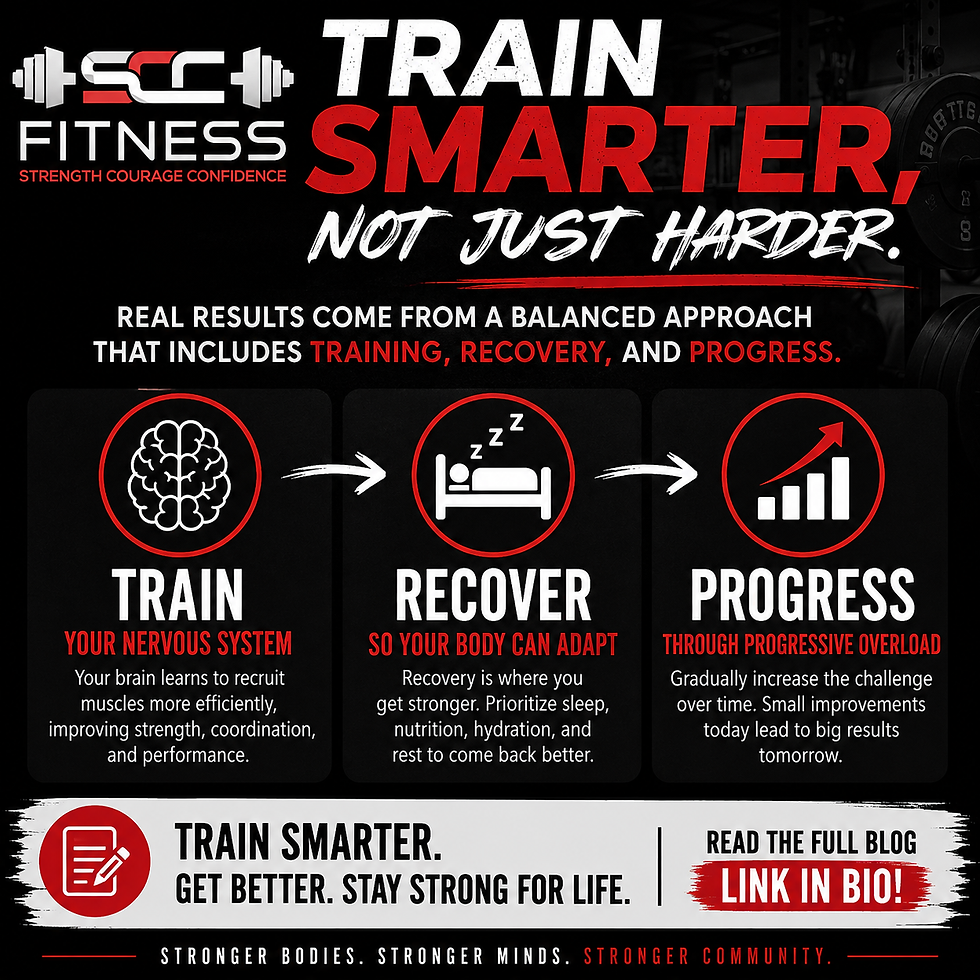
At SCC Fitness, we believe in training smarter—not just harder. Three of the biggest keys to long-term success are understanding how your nervous system adapts, why recovery is just as important as the workout itself, and how progressive overload drives continuous improvement.
Let's take a closer look.
Your Nervous System Gets Stronger Before Your Muscles Do
One of the biggest misconceptions about strength training is that your muscles are doing all the work.
The truth is, your brain and nervous system are the first things to adapt when you begin lifting weights.
During the first several weeks of a new strength program, you aren't adding large amounts of muscle yet. Instead, your nervous system is learning how to use the muscle you already have.
Think of your nervous system as the body's electrical wiring.
When you first start training, it's like driving on a winding dirt road. Signals from your brain to your muscles aren't as efficient as they could be.
With consistent training, those roads become smooth highways.
Your nervous system learns to:
Recruit more muscle fibers
Fire muscles more quickly
Coordinate muscles more efficiently
Produce greater force
Improve balance and stability
This is why many people become noticeably stronger during the first month of training—even if they don't look dramatically different in the mirror.
Strength is a skill, and like any skill, your body gets better at it through practice.
Recovery Is When You Actually Get Better
Here's something that surprises many people:
You don't get stronger during your workout.
You get stronger after your workout.
Training creates stress. Recovery allows your body to adapt to that stress.
Every workout causes small amounts of damage to muscle tissue and temporarily fatigues your nervous system. During recovery, your body repairs that tissue, replenishes energy stores, and prepares you to handle even greater challenges next time.
Without enough recovery, this process can't happen effectively.
Recovery includes:
Getting enough quality sleep
Eating adequate protein and carbohydrates
Staying hydrated
Managing life stress
Taking rest days
Using lighter training days when appropriate
Many people believe taking a day off means losing progress.
In reality, skipping recovery is far more likely to stall your progress than taking a planned rest day.
The goal isn't simply to train hard.
The goal is to recover well enough to train hard again.
Progressive Overload: The Secret Behind Every Successful Program
Once your body has recovered, it needs a new challenge.
That's where progressive overload comes in.
Progressive overload simply means asking your body to do a little more over time.
That doesn't always mean lifting heavier weights.
You can progressively overload your body by:
Adding a small amount of weight
Performing an extra repetition
Completing another set
Improving your exercise technique
Increasing range of motion
Reducing rest periods
Moving the same weight with greater speed or control
Small improvements add up.
Adding five pounds to a lift every few weeks may not seem exciting, but over the course of a year, those small increases become significant improvements in strength and fitness.
Many people chase random workouts because they feel challenging.
The problem is that random workouts make it difficult to measure progress.
A well-designed program tracks performance and gradually increases the demands placed on your body at the right time.
That's how lasting results are built.
Why More Isn't Better
One of the biggest mistakes people make is believing they need to constantly push harder.
If your nervous system hasn't recovered, your performance declines.
If your muscles haven't recovered, your strength decreases.
If you continue adding stress without allowing adaptation, progress slows—and injuries become more likely.
This is why elite athletes don't train at maximum intensity every day.
They alternate hard days with easier sessions, prioritize recovery, and follow structured programs that gradually increase training demands over time.
Ironically, the people who get the best results aren't necessarily the ones who work the hardest every day.
They're the ones who consistently recover, progress, and repeat the cycle.
Putting It All Together
Successful training follows a simple cycle:
Train: Challenge your muscles and nervous system.
Recover: Allow your body to repair and adapt.
Progress: Gradually increase the challenge.
Repeat: Stay consistent over weeks, months, and years.
Skip any one of these steps, and progress slows.
Master all three, and you'll continue getting stronger, healthier, and more capable for years to come.
The SCC Fitness Difference
At SCC Fitness, every program is designed with these principles in mind.
We don't believe in making every workout as hard as possible.
We believe in making every workout as effective as possible.
That means understanding when to push, when to recover, and how to progress in a way that keeps you improving—not just this month, but for the long haul.
Whether your goal is to lose weight, build muscle, improve athletic performance, or simply stay healthy enough to enjoy life, smart programming will always outperform random effort.
Because the best results don't come from working harder.
They come from training smarter.
Comments